


1) Jumping monkeys are diurnal and "live by sight"
They hunt with their eyes, so they need:
sensibledaylight(no heating with a "happy" lamp),
structures for climbing and observing,
peace (excess stress = decreased appetite).
2) Hammock near the ceiling = the terrarium can NOT be opened only "from the top"
Jumping monkeys very often build a "hammock"/night cocoon near the mountain. If you have a terrarium that opens only from the top, you may destroy their spider webs and stress the animal with each service. Therefore, in practice, tanks withside / front access + good cross-ventilation work best.
3) We keep the jumping jacks individually
These are not "gregarious spiders". Jumping monkeys are cannibalistic, so the breeding standard is to keep them individually (exception: female with cocoon and young in a controlled stage).
Perfect setup
1) Terrarium and ventilation
Priority: ventilation and escape safety (they are fast and can pass through gaps).
Height > width (most species are arboreal/"wall").
Cross-vent (openings on opposite sides, at different heights) - reduces stuffiness and mold.
Side doors or service through the side/bottom - so as not to destroy the hammock.
2) Interior – what must be there
2-3 different textures for climbing (cork bark, twigs, dry vegetation, artificial elements with texture).
1-2ceiling-high hiding places (flat slots, small cork tube, bark "roof") - jumping jacks like to build a hammock between the planes.
For most species, a substrate is not necessary (it is easier to keep clean), but it can help stabilize micro-humidity - it is important not to create a "sauna".
3) Hydration (no risk of drowning)
Jumping monkeys drink from drops: sprinkling the wall/decoration witha very fine mist.
Absolutely avoid large drops in young children: drops larger than the little ones can drown themince - the mist should be super delicate.
Additionally, you can use "safe water points": a piece of sponge, a cotton swab, water gel (so that there is no deep surface).
C. Feeding Jumpers (A Practice That Works)
1) What they eat (most often)
Fruit flies (Drosophila) – a must have for young ones.
Small flies, mini-crickets, small cockroaches (e.g. nymphs), depending on the size of the spider.
2) How often to feed (indicative)
In breeding, the most reliable rule is: feed according to the appearance of the abdomen, not according to the calendar.
For Phidippus regius, the Tarantula Collective provides practical ranges: from more frequent feeding of young to 1-2 feedings per week in adults, with prey selected according to size (often about 2/3 of the spider's size as a safe reference point).
3) "My jumping jack doesn't eat" – diagnostic procedure (don't panic)
Most common causes:
Pre-molt: the spider locks itself in a hammock and stops hunting - then do not feed or "force".
Too much prey: A jumping jack can be "brave", but if the prey stresses it out, it will stop going out.
Too dark / lack of daily rhythm: these are day hunters.
Dehydration: no drops to drink = lethargy and lack of appetite.
Stress: rummaging in the terrarium, breaking the hammock, vibrations.
Rule: if he doesn't eat - take out the food, provide water on the walls, leave it alone and try again in a few days.
D. Moulting in jumping jacks: how to help and why it sometimes ends badly
1) What does a jumping jack molt look like?
Jumping monkeys usually moltin a hammock (a closed cocoon made of spider web). After molting, they often stay there for a while until the new skin hardens.
2) What to do before molting
Maintain constant access to water droplets (fine mist).
Don't leave the "chewy" feed inside.
Don't tear the hammock apart "just to check".
3) Why do jumping jacks die during molting (most often)
Dehydration (too dry + not drinking from the drops) → there is no "strength" to get out of the cuticle.
Destruction of the hammock / stress (a common mistake in terrariums opening from the top). (Por Amor Art)
Risky food left inside.
Stuffiness and mold with poor ventilation (especially when someone "pours water" instead of creating a fine mist and air).
In practice: if a jumping jack is in a hammock and "disappears" - it is often a sign that the molt is approaching. The best help is… peace of mind + gentle watering of the walls.
E. Reproduction of jumping jacks (for breeders, not for the first time)
1) Key facts
Females of many species (especially wild-caught ones) can layan unexpected cocoon - then it is standard to leave her alone, because she will guard it.
After the young ones leave, you usually have to take into accountseparation, because cannibalism is real.
2) Care of the young (the most important minimum)
Prepare the fly culture and feeding tools.
You feed the young with fine food (flies) and water with an ultra-fine mist.
Eggs/hatching: in practice, the hatching range is 1-4 weeks (depending on the species and conditions), and the young remain in the cocoon area for some time.
F. TOP jumping horses found in breeding (atlas cards)
Below are the 15 most populars (including some "classics" and a few "wow genres"). I'm numbering it as51–65so that it can be included in your TOP 50 tarantulas list.
51) Phidippus regius (skakun królewski) – 🟢
Origin/biotope: southeastern USA; especially common in Florida; associated with, among others, with “old fields” environments (open, plant areas).
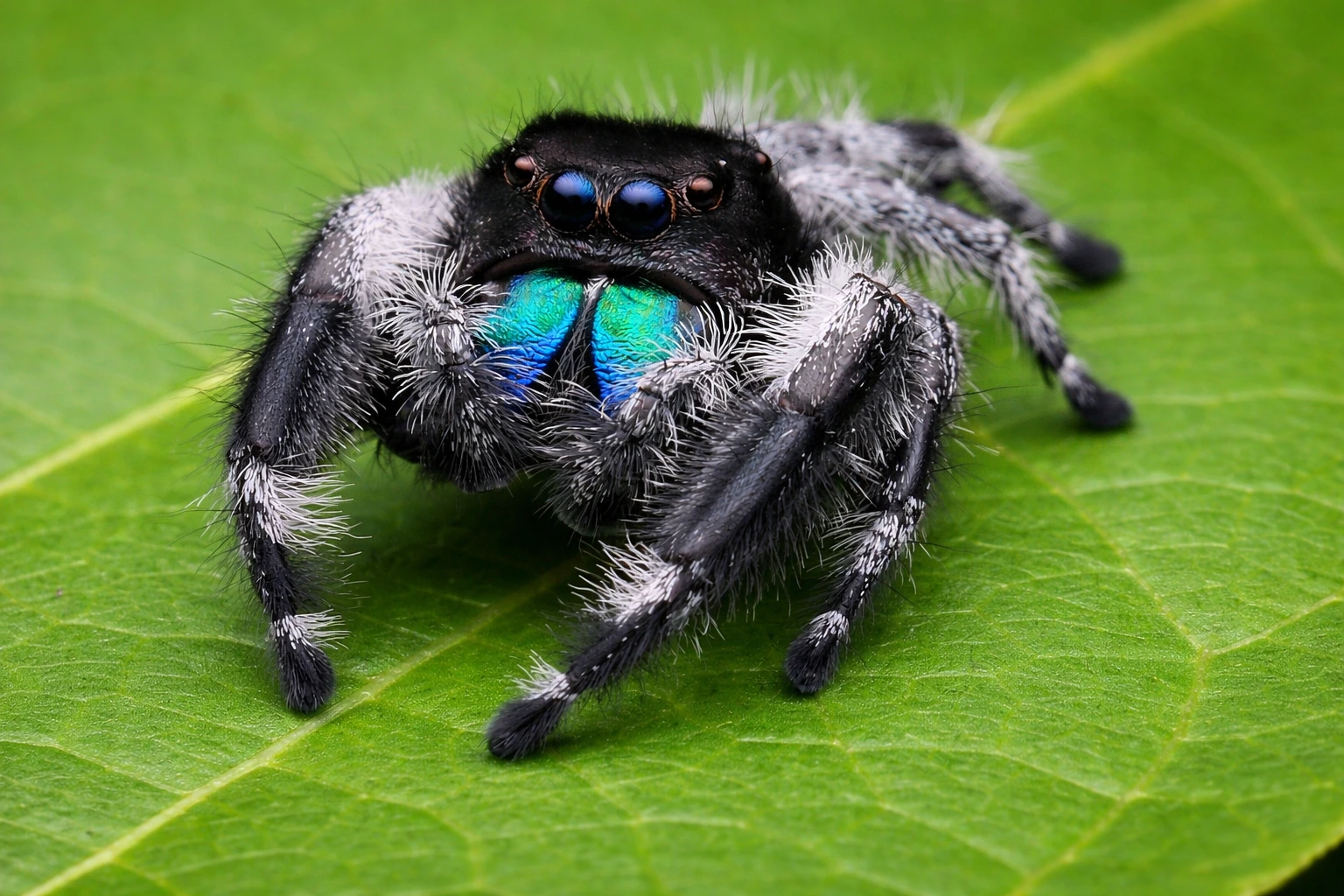
Feeding Phidippus regius – professional tips
Proper feeding of Phidippus regius (royal jumping spider) consists primarily in matchingthe type, size and frequency of foodto the spider's stage of development.
1. Type of food
Jumping monkeys are active predators - they respond best to live, moving insects.
Juveniles (L1–L4):
Drosophila melanogaster fruit flies,
springtails.
Juveniles (L5–L8):
larger Drosophila hydei flies,
little crickets,
small cockroaches (e.g. Turkish),
mealworm hatching.
Adults:
flies (from raised pins),
adult Turkish cockroaches,
crickets,
little moths,
occasionally mealworms (rather as a variety, not the basis of the diet).
2. Feeding frequency
The metabolic rate depends on the spider's age and ambient temperature.
Young (L1–L4):
feeding every day or every 1-2 days.
Juveniles and adults:
usually 2-3 times a week.
The best "indicator" is theabdomen:
strongly rounded - the spider is full, you can take a break,
visibly flattened or wrinkled - time to eat.
3. Size of the prey
Safe prey should beabout ¾ to 1.5 times the spider's body length.
too small offerings may be ignored,
too large (especially aggressive crickets) mayinjure the jumper, especially before or just after the molt.
4. Key safety rules
Wylinka:
when the spider encloses itself in dense weaving and significantly limits its activity, it is most likely preparing to molt - don't give food then;
give the first meal after the molt only aftera few daysuntil the new skin has completely hardened.
Removing leftovers and uneaten insects:
if the spider does not start hunting within a few hours, the insect should be removed from the terrarium,
this especially applies to crickets, which if left overnight can stress or even injure the jumper.
Lighting:
jumping jacks hunt mainly thanks to their excellent eyesight,
they needgood, bright lightto see the movement of the prey - in too low light they may refuse to hunt.
2) Phidippus audax skakun śmiałek (ang. bold jumping spider)
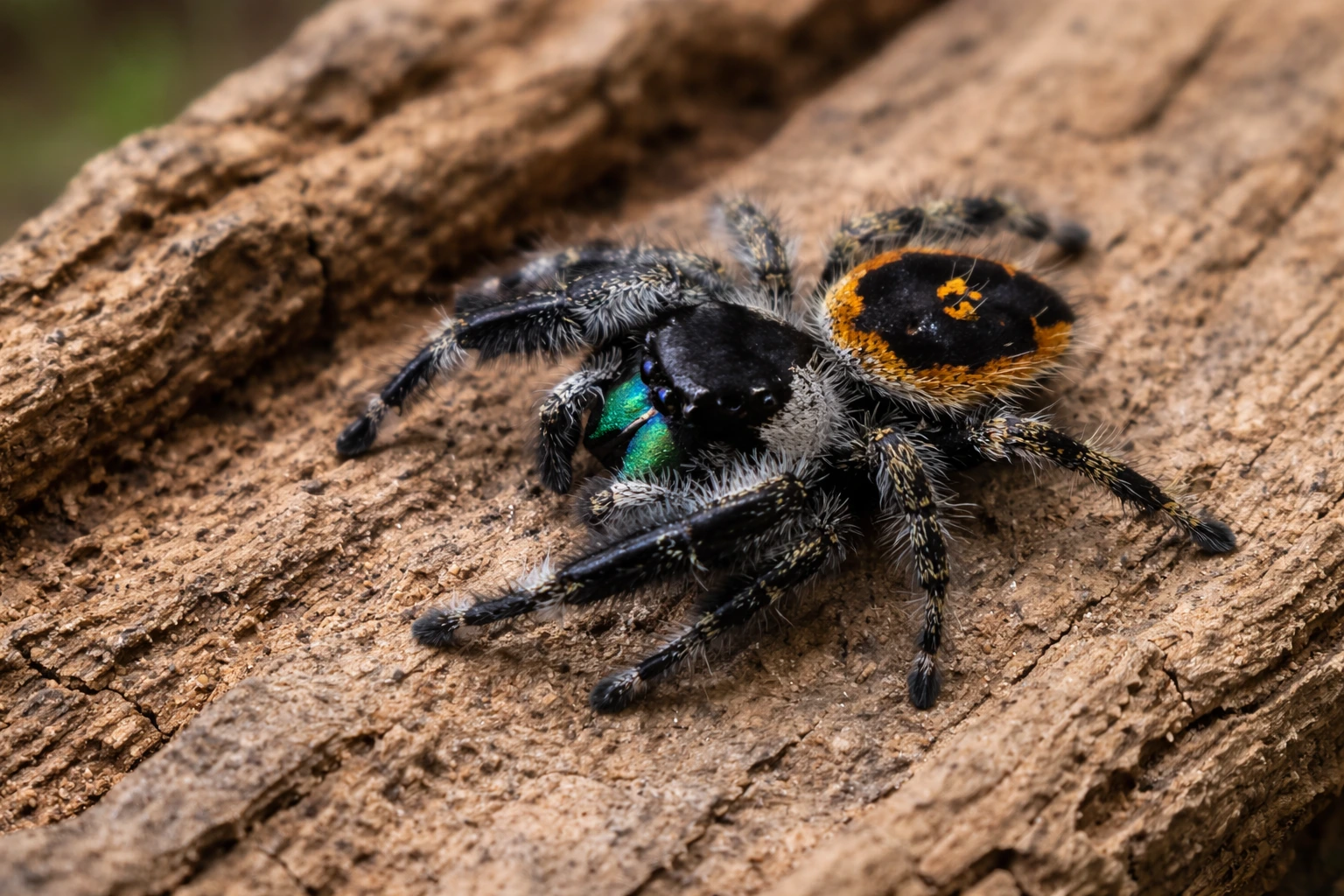
Origin/biotope: very wide in North America; open habitats: meadows, prairies, open forests, fields, gardens; often close to people.
Feeding Phidippus audax (daredevil jumping monkey) – in short
1. What do they eat?
Flies (domestic, blowflies, pinflies)
Little crickets
Cockroaches (Turkish, dubia – selected in size)
Little moths
Mealworm/wax moth larvae (as an addition)
Young (L1–L4):
Fruit flies (D. melanogaster, D. hydei)
A cricket hatching
2. The size of the sacrifice
Preferably an insect close in length to the body of a spider
Maximum approximately 1.5× the spider's length
Avoid very large, strong crickets
3. Feeding frequency
Young: every1–2 days
Juvenile: every2–3days
Adults: every 3–5 days (females usually eat more often)
Look at the abdomen:
full, rounded = spider full
small, wrinkled = time to feed
4. Water
They don't drink from a bowl
They drinkthe drops after lightly sprinklingthe walls/decorations
Do not overwater - it should be moist in spots, not wet
5. The most important safety rules
Do not feed: ants, hard-shelled beetles, large aggressive crickets
Remove uneaten insects after a few hours
At molt:
spider locked in gear = we don't feed
the first meal only a few days after molting
Breeding: similar to regius, usually hardy and graceful.
Plus: great for observing hunting behavior.
53) Hasarius adansoni (Adanson’s house jumper) – 🟢
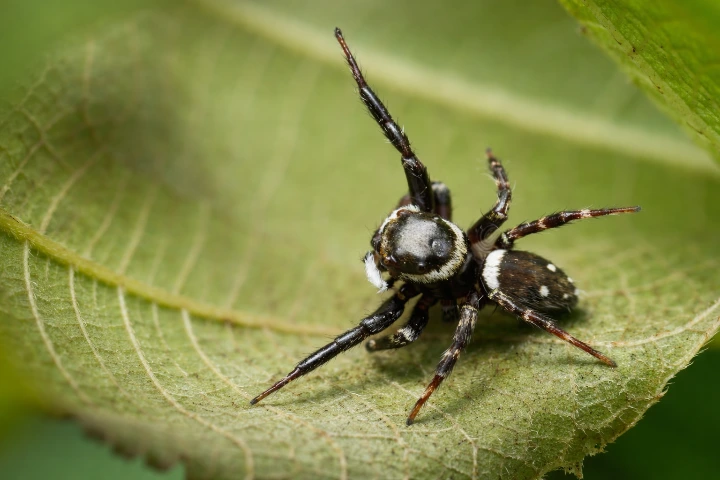
Origin/biotope: species "attached to humans" - warm regions of the world, often near buildings/interiors.
Hasarius adansoni, known as Adansona's househopper, is one of the most widespread spiders from the jumping spider family (Salticidae).
Characteristics and appearance
This species shows clear sexual dimorphism:
Males (6–8 mm) are mainly black, with a red "mask" around the eyes and white, pearly spots on the abdomen and pedipalps.
Females (7–10 mm) are slightly larger and less contrasting - dark brown or reddish, which makes it easier for them to camouflage.
Behavior and diet
It is anactive hunter - it does not build hunting nets, it relies on excellent eyesight and precise jumps. At night it creates silky retreats (tunnels) in which it rests.
Feeding
It feeds on small insects, most often flies, mosquitoes and other small insects. In breeding, small insects matched in size are usually given (the prey should not be larger than the spider); it's best to feed small portions every few days and remove uneaten insects.
Occurrence
It probably comes from Africa, but is now a cosmopolitan species. In warmer climates it occurs outdoors, while in colder countries (e.g. Poland) it is found mainly in heated facilities such as greenhouses or palm houses.
Security
It is harmless to humans - bites are rare and usually do not have serious consequences.
Breeding: small terrarium, lots of vertical surfaces; it tolerates typical home conditions well, as long as it has air and drops of water.
Errors: too wet + lack of ventilation.
4)Menemerus bivittatus (gray wall spider)
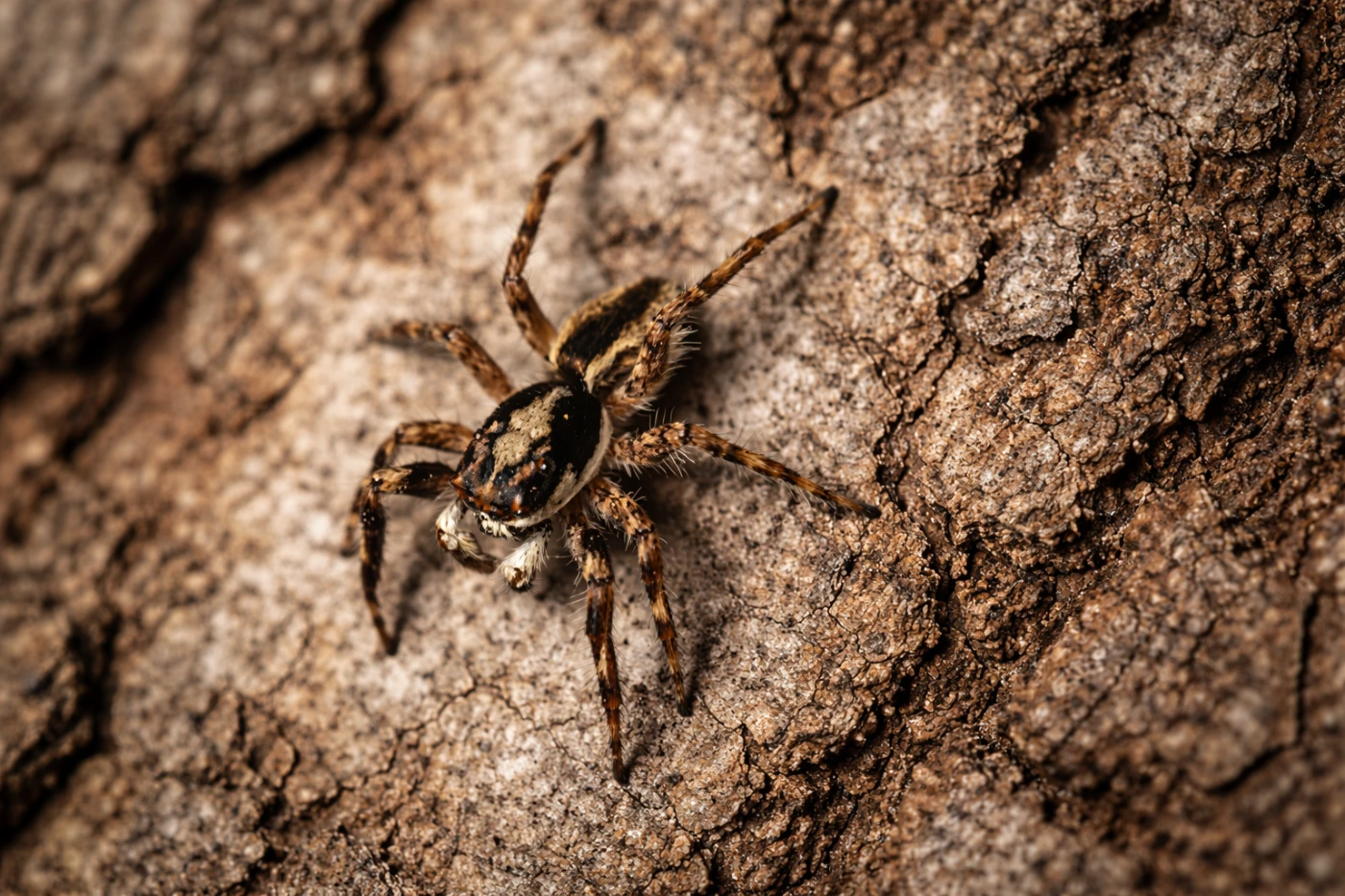
Feeding the Menemerus bivittatus spider (wall jumper) depends mainly on the age and availability of prey. It is an active hunter with excellent eyesight - it does not build hunting nets, but tracks its prey and attacks it by jumping.
What to serve?
In nature and in breeding, the diet is based onlive insects:
Most common: small flies, mosquitoes, fruit flies, moths.
In breeding: flightless fruit flies (Drosophila melanogaster for young ones, D. hydei for adults), small crickets ("pinheads"), hatching cockroaches, possibly small mealworms.
Prey size: preferably it should beequal to or slightly smallerthan the spider (approx. 50-100% of the body length), although jumping jacks can also hunt larger insects.
How often to feed?
Adult: every3–5 days.
Youngs: more often, usually every 1-2 days.
Water
Jumping monkeys usually don't drink from bowls - it's better to gently spray one wall of the terrarium with water mist every 2-3 days so that the spider can lick the drops.
Important tips
Remove uneaten insects after about 24 hours so that they do not stress the spider (crickets can even bite it, especially during molting).
Avoidants and hard-armored beetles - they can hurt the spider or defend themselves effectively.
Moult: When the spider encases itself in its thick white weaving and stops eating, do not feed it or disturb it until the process is complete.
5) Plexippus paykulli (pantropical jumping spider)
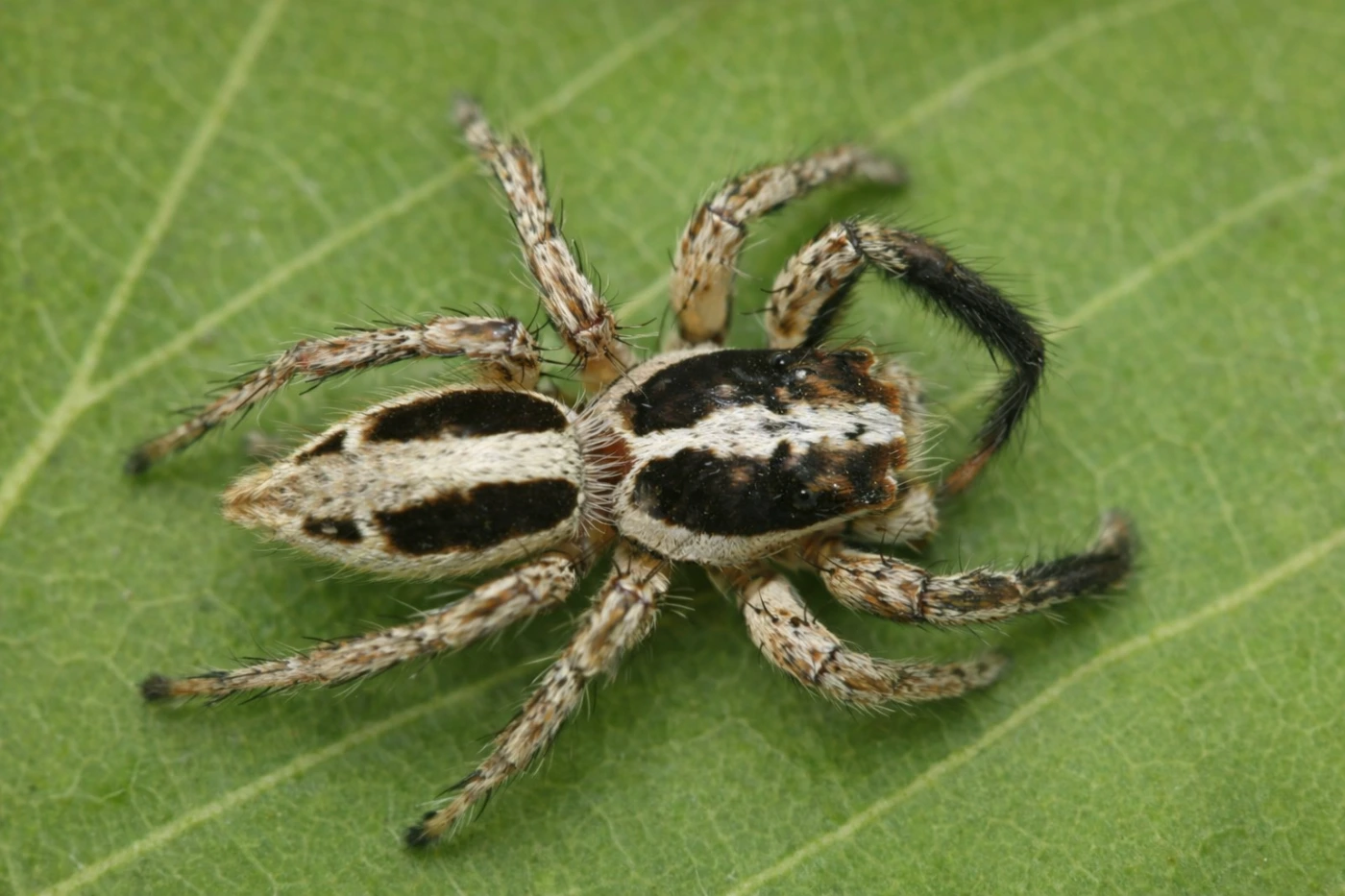
Plexippus paykulli, known as pantropical jumping spider, is a species closely related to the wall jumper with acosmopolitan range, especially common in warm climate zones. In Poland, it is less common than Menemerus bivittatus, but both species can inhabit similar places - primarily walls of buildings and around artificial light sources.
Appearance and identification
Size: adults are usually 9–12 mm, withfemales usually being slightly larger than males.
Sexual dimorphism:
Male: highly contrasting,black and white. On the abdomen it has a light central stripe surrounded by darker stripes and two white spots at the end of the abdomen.
Female: more subdued, brown-grey; a darker area is visible around the eyes, and a lighter stripe (orange or fawn) runs across the back.
Difference from M. bivittatus: it is easiest to distinguish them by the arrangement of stripes on the abdomen - inP. paykullithe center is lightand the sides are dark, while inM. bivittatus on the contrary: dark center, lighter sides.
Feeding and hunting
Diet: generalist predator - hunts, among others, against flies, mosquitoes, moths, winged ants, and sometimes also againstother spiders.
Technique: does not build fishing nets; it looks for its prey and attacks by jumping, able to overpower insects even larger than itself.
Strategy: it often lurks near external lamps, where it catches insects attracted by the light.
Breeding conditions
If you plan to breed in a terrarium:
Temperature: preferably 22-28°C, avoid constant temperatures above 30°C.
Humidity: moderate, approx. 50–60%; just lightly sprinkling the wall 1-2 times a week is enough.
Feeding frequency: adults 2-3 times a week, young ones every day or every other day.
6) Phidippus johnsoni red-backed jumping spider
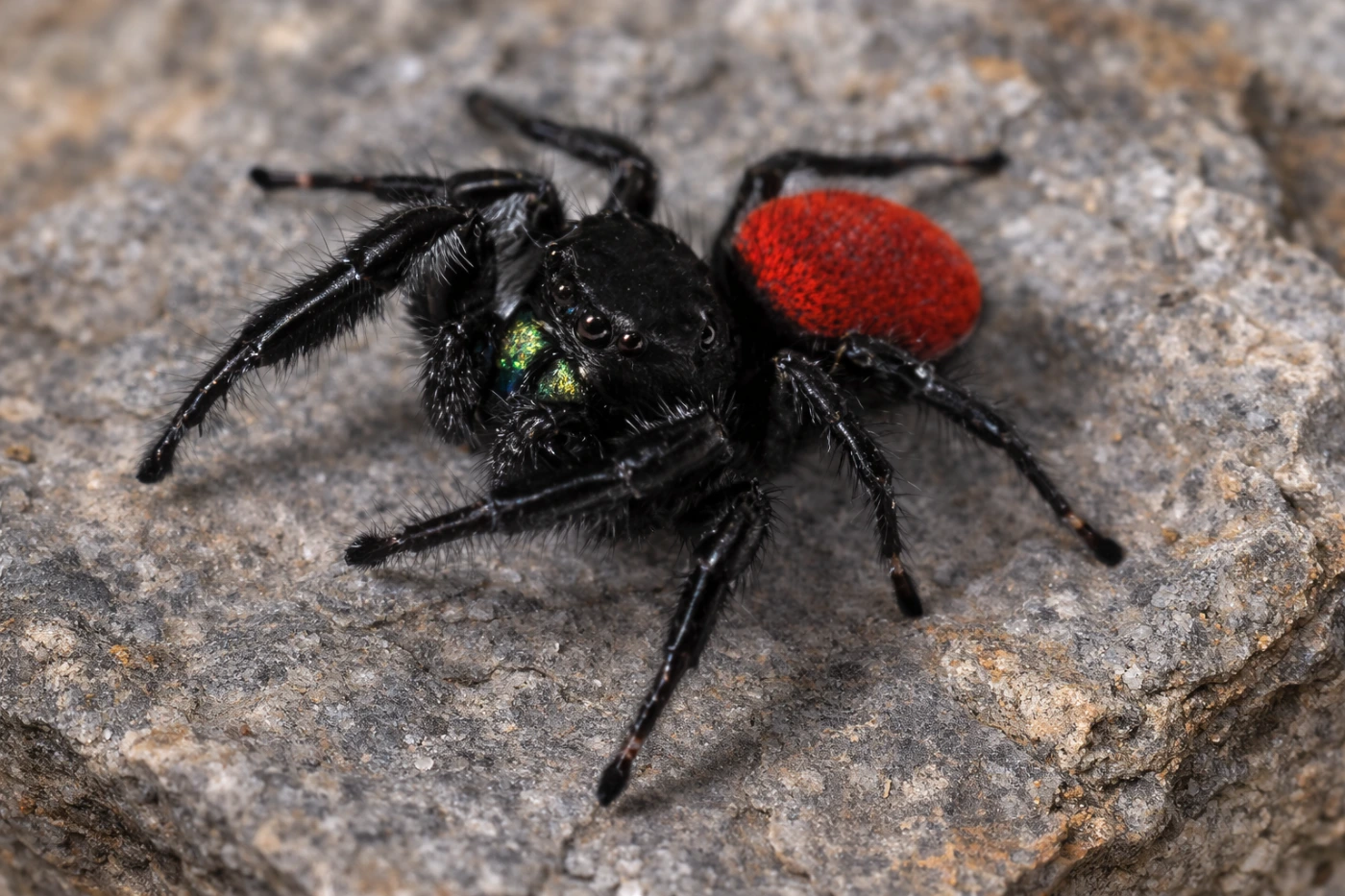
Phidippus johnsoni, commonly known as the red-backed jumping spider, is one of the largest and most common jumping spiders in western North America.
Key features and appearance
Sexual dimorphism:
Males have an intensely red abdomen over the entire upper surface. Females also have a red abdomen, but there is a characteristic black stripe running through its center.
Color:
The cephalothorax and legs are black. Chelicerae often have a metallic sheen in shades of turquoise or green.
Size:
Females: 9–14 mm body length
Males: approximately 6–11 mm
Mimikra:
This species resembles dangerous stingers from the dasymutilla family, which is an effective form of defense against predators.
Behavior and habitat
Active hunter:
Like all jumping creatures, it does not build hunting nets. It is distinguished by excellent eyesight and precise jumping ability, which allows it to hunt effectively.
Occurrence:
It inhabits areas from sea level to mountainous areas in western Canada, the United States and northern Mexico.
Interesting fact:
In 2012, an individual of this species was sent by NASA to the International Space Station to test its hunting abilities in microgravity conditions.
Nutrition
Phidippus johnsoni is a predator that hunts actively during the day. His diet mainly includes:
flies and other flying insects,
caterpillars,
beetles,
smaller spiders (including other jumping spiders).
Hunting involves slowly sneaking up to the prey, accurately assessing the distance by sight, and then making a precise jump. After catching its prey, the spider injects venom, which immobilizes the prey and begins the process of external digestion - enzymes break down the tissues, which are then sucked out.
Thanks to its excellent eyesight and agility, the red-bellied jumping jack is one of the most effective small predators in its environment.
7) Phidippus regius czy P. audax
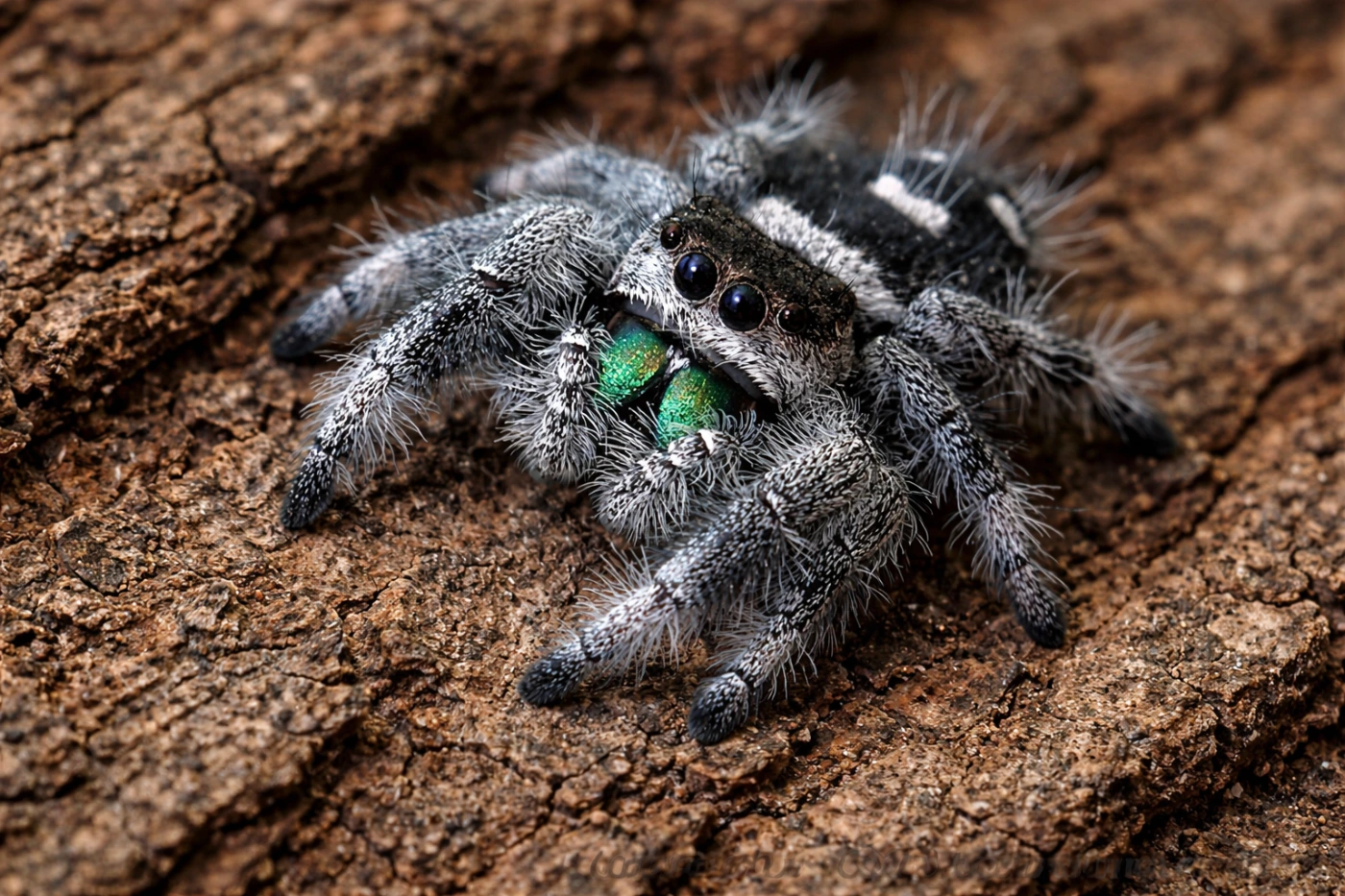
Feeding jumping jacks (e.g. Phidippus regius, P. audax)
The diet of a "standard" jumping jack depends primarily on the stage of development and the current condition of the abdomen. Jumping monkeys are active predators and requirelive foodthat stimulates their hunting instinct.
1. Type of food depending on age
The selection of the victim should be based on the principle:
size of prey = approximately ¾ to 1.5 times the length of the spider's body.
Young (L1–L4)
Drosophila melanogaster fruit flies (smaller ones),
Drosophila hydei (larger, flightless).
Adults (L5–L7)
larger fruit flies,
freshly hatched crickets (hatching),
small cockroaches (e.g. Turkish),
young locust.
Adult (L8+)
houseflies (bred from pines),
adult crickets,
cockroaches,
locust,
wax moths (occasionally - as a caloric delicacy).
2. Feeding frequency
Instead of a rigid schedule, it is best to observe the spider's abdomen.
Young individuals: every 1–3 days (they grow intensively).
Adults: every 3–7 days (females usually eat more often than males).
Abdomen index:
Large and round - we do not feed.
Flat or slightly wrinkled - the spider is hungry or dehydrated.
3. Important rules and safety
Irrigation:
Jumping monkeys don't drink from cups. You should gently sprinkle one wall of the terrarium every 1-2 days (a light mist) so that the water drops can absorb them.
Safety of victims:
Do not leave crickets or other active insects in the terrarium unattended, especially at night. They can injure the spider, especially during molting.
Wylinka (molt):
If the spider gets trapped in the thick webbing and stops eating, do not feed it. During the molt, it is very sensitive and the presence of prey may pose a threat.
Diversification of diet:
It is worth using a variety of food and the so-called gut-loading (feeding feeder insects with nutritious food) to provide the spider with the right amount of nutrients.
Appropriate nutrition and monitoring the condition of the abdomen are the key to the healthy development and long life of a ski jumping animal.
58) Hyllus diardi (heavy jumper) – 🟡
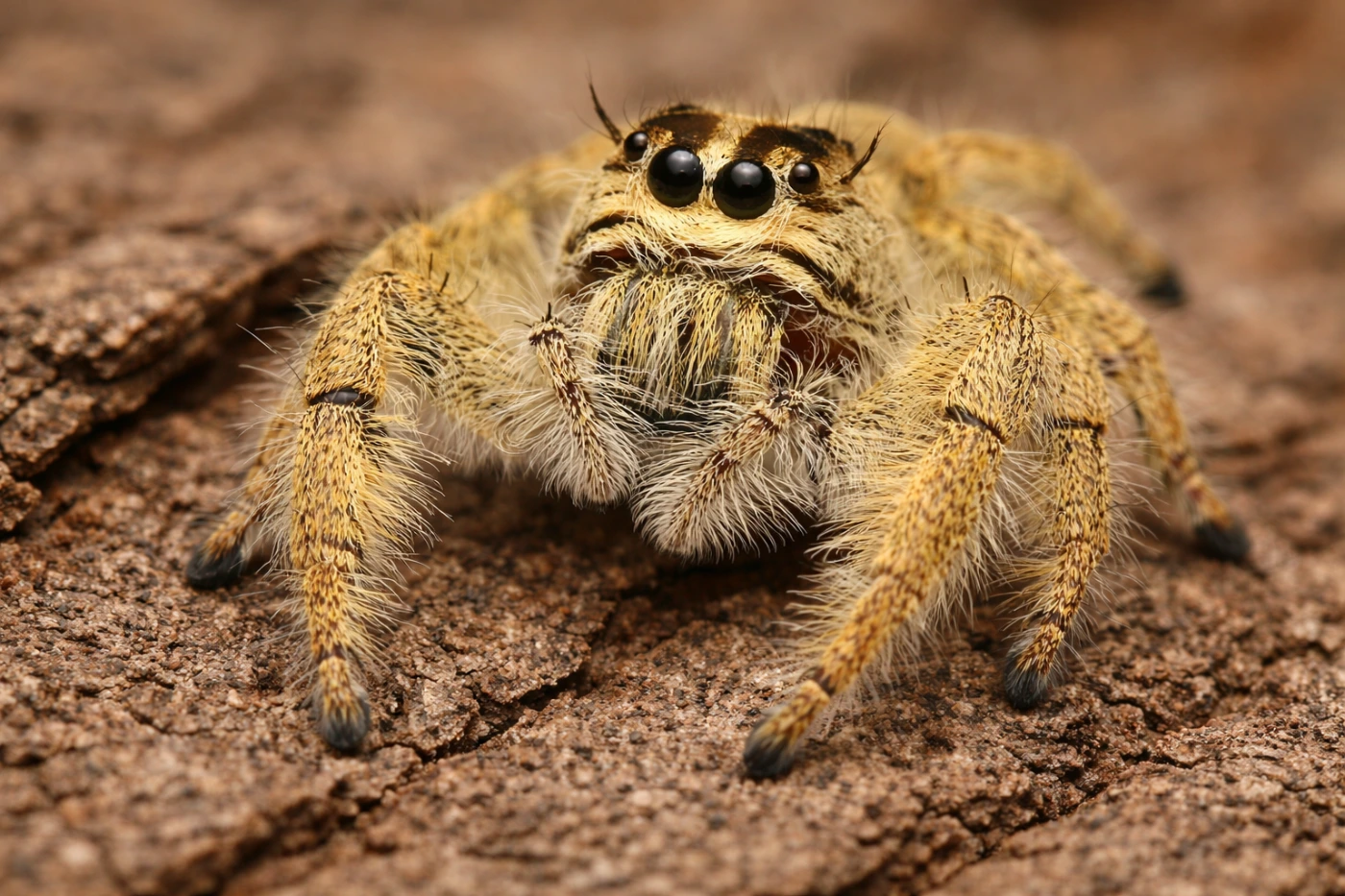
Nutrition of Hyllus diardi (heavy jumping creature)
Proper feeding of Hyllus diardi requires adapting the type and size of food to the spider's stage of development and regularly ensuring its hydration.
What to feed? (Type of food)
Young individuals (L1–L3)
Drosophila melanogaster flightless fruit flies.
Juveniles (L4–L7)
larger fruit flies (Drosophila hydei),
small crickets ("pinheads"),
freshly hatched cockroaches.
Adults
houseflies (hatched from pins),
wax moths (occasionally, as a more caloric food),
small crickets,
Turkish cockroaches,
small locusts.
Hint:
Insects caught in the wild should not be given due to the risk of parasites and exposure to pesticides.
Feeding frequency and amount
Young individuals: every 2-3 days.
Adults: every 3–7 days.
Prey size:
The prey should not exceed about 1.5 times the length of the spider's body.
Key safety rules
Observation of the abdomen:
The best indicator of the amount of food is the appearance of the abdomen - it should be slightly rounded. An excessively enlarged abdomen increases the risk of injury (e.g. rupture during a fall).
Removing leftovers:
Uneaten insects, especially crickets and mealworms, should be removed from the terrarium if the spider shows no interest in them. They can injure your jumping jack, especially during the molt.
Wylinka:
When the spider encloses itself in dense weeds and stops eating, it should not be disturbed or given food. During this period he is extremely sensitive.
Irrigation:
Jumping monkeys don't drink from bowls. Every 2-3 days, lightly sprinkle one wall of the terrarium so that small drops of water can absorb them.
Appropriate nutrition, control of the size of the abdomen and following safety rules are the basis for the healthy development of Hyllus diardi. Errors: Too slippery, "empty" terrarium without textures → stress and lower activity.
59) Hyllus semicupreus / sp. (hobby) – 🟡/🔴
Notes: There is taxonomic confusion in the trade (various “Hyllus sp.”).
Breeding: as in Hyllus: vertical space, strong decorations, do not overheat.
60) Marpissa muscosa (bark jumper) – 🟡
Why interesting: "bark and trunks" is its atmosphere - great for arrangements with bark/hiding places.
Breeding: vertical + lots of bark and crevices; don't make it too wet.
61) Pseudeuophrys lanigera / sp. (small “domestic” jumping jacks) – 🟡
Plus: micro-format, low costs, cool behavior.
Minus: small size = more difficult feeding (obligatory flies).
62) Salticus scenicus (skakun arlekinowy) – 🟡
Note: It is not an "exotic", but it is sometimes considered by ski jumping fans as the "first skydiving bird to observe".
Breeding: simple, but remember about legality and ethics (better CB than caught from nature).
63) Maratus volans (peacock spider) – 🔴 (rather for enthusiasts)
Biotope: Australia; found, among others, in open forests and places with a layer of leaves/litter; some field observations indicate dry/light habitats with leaves, sand and grasses.
Breeding: small, delicate, requires very carefully considered conditions; in practice more difficult than Phidippus.
For SpotMeUp: great visual content (mating dance), but not as a "first jumper".
64) Maratus literatus (i inne Maratus) – 🔴
Notes: Some sources emphasize that these are more difficult spiders, with specific requirements and small size, requiring good ventilation and rather dry conditions.
65)“Phidippus sp.” (local varieties/morphs in breeding) – 🟡
Practice: You will encounter various locations/morphs in rotation. From the atlas' point of view: you describe it as Phidippus, but you add the column "origin of the lineage (CB/WC), location".
G. Mini-section "Bugs that kill jumping jacks"
Terrarium opened only from the top → you destroy the hammock and cause chronic stress.
“Humidity” as in tropical tarantulas → stuffiness, mold, condition decreases.
Large water drops in toddlers → risk of drowning.
Leaving feed in the pre-molt / in the hammock.
Holding together (“because it's so cute”) → cannibalism.
Thank you for reading this article
Blog Master
